The following is a tentative program schedule for the minisymposium. Please check back here for the most up-to-date information.
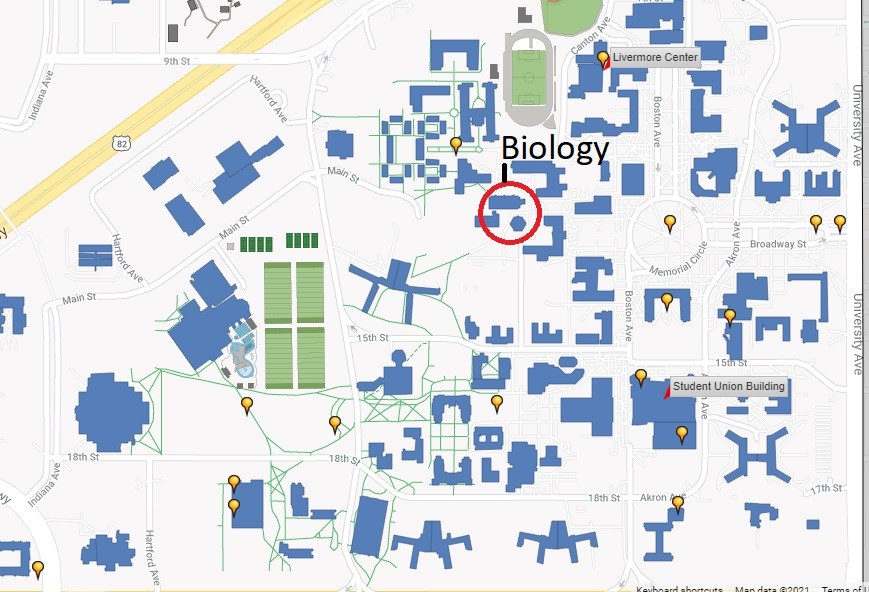
In order to help participants find the Biology building (which is where all in-person talks will take place), please see this
map.
For further clarity, see the map below (which has the biology building highlighted).
Friday, August 20, 2021 [Location: BIOL 101 and 102]
1:15 - 1:25 PM
Welcome and opening remarks
1:30 - 2:20 PM
Alun Lloyd — Stochasticity and Heterogeneity in the Aedes aegypti/Dengue Transmission System: Implications for Spread and Control of Infection
Abstract: The Aedes aegypti mosquito is the vector for several infections of public health concern, including dengue, chikungunya, Zika and yellow fever. The mosquito lives in close proximity to humans, typically only disperses over short distances and its population density is often highly heterogeneous across space. As a result, the transmission dynamics of the infections it vectors are subject to significant heterogeneity which must be accounted for when modelling the spread and control of these infections. Through a series of vignettes, we will discuss some of this modelling, utilizing a number of different mathematical and simulation frameworks---from deterministic and stochastic multi-patch models through to cohort or individual-based simulation models. Pros and cons of the various approaches will be discussed.
2:30 - 3:20 PM
Christina Edholm — Heterogeneity in Transmission for Superspreaders
Abstract: The importance of host transmissibility in disease emergence has been demonstrated in historical and recent pandemics that involve infectious individuals, known as superspreaders, who are capable of transmitting the infection to a large number of susceptible individuals. To investigate the impact of superspreaders on epidemic dynamics, we formulate deterministic and stochastic models that incorporate differences in superspreaders versus nonsuperspreaders. In particular, continuous-time Markov chain models are used to investigate epidemic features associated with the presence of superspreaders in a population. We parameterize the models for two case studies, Middle East respiratory syndrome (MERS) and Ebola. In this talk, we will explore how superspreaders and environmental variability impact important epidemiological measures via mathematical analysis and numerical simulations.
3:30 - 5:30 PM
In-person poster session
Saturday, August 21, 2021 [Location: BIOL 101 and 102]
8:30 - 9:20 AM
Spencer Hall — Heterogeneity in food web modules of disease: a look at infection classes and resources, host evolution and resources, and stage-structure and predators
Abstract: Heterogeneity in disease systems, like in all of ecology, abounds. If we embrace that heterogeneity, we can understand and predict outcomes that otherwise seem surprising. To illustrate, I'll show three examples. First, heterogeneity of hosts due to infection can make stable host-resource systems oscillate but oscillatory host-resource system stable. I show this mathematically, by tracing the implications of disease-mediated trophic cascades onto resource density-dependence to stability via feedback loops. Next, I show how those disease-mediated cascades can lead to evolution of increased host susceptibility (not resistance) – and larger (not smaller) disease epidemics. I show these results with an experiment and model of adaptive dynamics. Finally, with field, experiments, and models, I illustrate how predators which cull juveniles can shift populations towards adult stages. Such 'culling the young' then can create larger, not smaller epidemics. All three examples illustrate how host heterogeneity (infection, genetic, stage) and resources, together, can produce outcomes in disease systems that seem hard that would seem to contradict the norm.
9:30 - 10:20 AM
Jude Kong — Phytoplankton competition for nutrients and light in a stratified lake: a mathematical model connecting epilimnion and hypolimnion
Abstract: In this talk, I will present several mathematical models describing the vertical distribution of phytoplankton in the water column. In particular, I will introduce a new mathematical model connecting epilimnion and hypolimnion to describe the growth of phytoplankton limited by nutrients and light in a stratified lake. Stratification separates the lake with a horizontal plane called thermocline into two zones: epilimnion and hypolimnion. The epilimnion is the upper zone which is warm (lighter) and well-mixed; and the hypolimnion is the bottom colder zone which is usually dark and relatively undisturbed. The growth of phytoplankton in the water column depends on two essential resources: nutrients and light. The critical thresholds for settling speed of phytoplankton cells in the thermocline and the loss rate of phytoplankton are established, which determine the survival or extirpation of phytoplankton in epilimnion and hypolimnion. This is a joint work with Jimin Zhang (Heilongjiang University), Junping Shi (William & Mary) and Hao Wang (University of Alberta).
10:30 - 11:00 AM
Break
11:00 - 11:50 AM
Mark Lewis — Mathematical Analysis of Animal Movement Patterns
Abstract: Animal movement patterns have long been the subject of mathematical and ecological interest. How do individual behavioral decision rules translate into macroscale patterns of space use such as foraging, patrolling or territories? I will show how mechanistic models, using random walks, stochastic processes, first passage time analysis and partial differential equations can be used to connect underlying processes to the observed patterns. Here interactions are complex and may involve memory of past events, as well as a cognitive map. I will make applications to a spectrum of different emerging patterns, ranging from territories in Amazonian birds to patrolling in wolves to seasonal movement patterns in grizzly bears.
12:00 - 1:30 PM
Lunch break
1:30 - 2:50 PM
Joel Brown — Using Evolutionary Game Theory to Model, Understand and Treat Cancer
Abstract: Here I present cancer and therapy as an evolutionary game. Instead of a disease of unregulated proliferation or a disease of the genes, cancer is a speciation event where a multicellular organism gives rise to a new single celled pathogen. The cancer cell lineage goes from being a part of the whole organism’s traits to becoming a self-defined fitness function. Cancer happens when the cell becomes the unit of natural selection. Within their tumor ecosystem, cancer cells experience and contribute to heterogeneity that selects for the evolution and coexistence of different cancer “species”. The cancer cells engage in public goods games, tragedies of the commons and competition for scarce resources. Between patients with the same cancer, one sees a high degree of functional and morphological convergent evolution. Tumor growth, metastases and ill-health to the patient all become emergent properties of cancer’s eco-evolutionary dynamics. Treatment becomes part of the game where the physician can and should be the leader in a Stackelberg Game. This gives rise to evolutionarily informed therapies where the goal is to anticipate and steer the cancer’s ecology and evolution. A clinical trial of advanced metastatic prostate cancer has more than doubled progression free survival. Additional clinical trials show a lockstep between mathematical modelling and clinical application. In two forms, adaptive therapy aims to contain an otherwise incurable stage of cancer, and, more recently, extinction therapy applies ecological and evolutionary principles to engineer the cure of otherwise incurable cancers by engaging the cancer in a kind of chess match.
3:00 - 3:50 PM
Elizabeth Hobson — The evolution of decision-making, social cognition, and complex sociality
Abstract: In many social species individuals create their social worlds through interaction decisions and are then subject to and constrained by these social constructs, which can affect an individual’s future actions. Understanding how much individuals “know” about their social worlds is critical in understanding these potential feedbacks. However, it is difficult to determine how much information individuals have about the social structures in which they live. I present new computational methods that make detecting the presence and use of social information more tractable and serve as social assays to categorize the social dominance patterns used to direct aggression within dominance hierarchies. Using a historical dataset containing 85 species, I will show how custom-built reference models can allow us to detect the presence and use of information and heterogeneity in rank-based aggression patterns. These approaches, and a taxonomically broad perspective, provide new opportunities to investigate the effect of social information on individual behavior within conflict, and has the potential to provide rigorous evidence for the evolutionary patterns underlying social cognition.
4:00 - 5:30 PM
Remote poster session
Registered Participants
The following is a list of registered participants for the minisymposium. Those who are presented posters have their titles and abstracts listed, as well.
Participant
Poster Title and Abstract (if applicable)
Odelola Veronica Abimbola
Osun State University
Abdulakeem Adams
Federal University of Agriculture, Abeokuta Nigeria
Antifungal activities of Wood Ash extract of Delonix regia and Mangifera indica against selected fungal plant pathogens
Abstract: Abstract to come...
Adeola Adeboje
University of Kansas
Samuel Adeniyi Adeleye
Rutgers University, New-Brunswick
Title (TBA)
Abstract: Abstract to come...
Bukola Muibat Adenuga
University of Ibadan
Modeling the Growth of Four Rabbit Breeds
Abstract: Abstract to come...
Akande Oluwatosin Adetoye
Ladoke Akintola University of Technology Ogbomoso, Nigeria
Joshua Oluwasegun Agbomola
Tai Solarin University of Education
Bifurcation analysis and dynamical behavior of an Ebola virus model with Saturated incidence
Abstract: Abstract to come...
Linda J. S. Allen
Texas Tech University
Elena Aruffo
York University
Mohammed Althubyani
York University
Lale Asik
University of the Incarnate Word
Elements of disease in a changing world: modelling feedbacks between infectious disease and ecosystems
Abstract: An overlooked effect of ecosystem eutrophication is the potential to alter disease dynamics in primary producers, inducing disease-mediated feedbacks that alter net primary productivity and elemental recycling. Models in disease ecology rarely track organisms past death, yet death from infection can alter important ecosystem processes including elemental recycling rates and nutrient supply to living hosts. In contrast, models in ecosystem ecology rarely track disease dynamics, yet elemental nutrient pools (e.g. nitrogen, phosphorus) can regulate important disease processes including pathogen reproduction and transmission. Thus, both disease and ecosystem ecology stand to grow as fields by exploring questions that arise at their intersection. However, we currently lack a framework explicitly linking these disciplines. We developed a stoichiometric model using elemental currencies to track primary producer biomass (carbon) in vegetation and soil pools, and to track prevalence and the basic reproduction number (R0) of a directly transmitted pathogen. This model, parameterized for a deciduous forest, demonstrates that anthropogenic nutrient supply can interact with disease to qualitatively alter both ecosystem and disease dynamics. Using this element-focused approach, we identify knowledge gaps and generate predictions about the impact of anthropogenic nutrient supply rates on infectious disease and feedbacks to ecosystem carbon and nutrient cycling.
Oladejo Ayobukola
Federal University of Technology, Akure
Salmonella Infections: The Increased Incidence of Foodborne illness outbreak, Antimicrobial-Resistance, Effects on the economy and Prevention
Abstract: Abstract to come...
Bamigbade Gafar Babatunde
Crescent University, Abeokuta, Ogun State, Nigeria
Antifungal Activities of Lactic Acid Bacteria Isolated during Fermentation of Cassava
Abstract: Abstract to come...
Harsimran Bains
Texas Tech University
Mathew Beauregard
Stephen F. Austin State University
Ohiocheoya Benjamin
University of Benin
Zac Bergeron
Kansas State University
Basic Proof of Finite Speed of Propagation in One Dimensional Degenerate Einstein Brownian Motion Model
Abstract: Abstract to come...
Jordan Bramble
University of Kansas
Stochastic Modelling of Event-Based SARS-CoV-2 Superspreading
Abstract: Abstract to come...
Gillian Carr
St. Mary's College of Maryland
Traveling Band Model for E. coli Transport in the Presence of Limited Immovable Food using the Einstein Paradigm of Brownian Motion
Abstract: Abstract to come...
Nydia Chang
Rutgers University
Mohammad Mihrab Uddin Chowdhury
Texas Tech University
Mitigating the Losses of COVID -19 variants breakthrough following vaccination
Abstract: Abstract to come...
Pauline Clin
Agrocampus Ouest, Rennes, France
Immune priming and the limited diversity of resistance genes in host mixtures
Abstract: Abstract to come...
Hunter Covey
Texas Tech University
Jared Cullingford
Texas Tech University
Peaceman Model for Well-Block and Steady-State Einstein Paradigm of Brownian Motion
Abstract: Abstract to come...
Olanrewaju Dada
Mountain Top University, Makogi
Sachith Eranga Dassanayaka
Texas Tech University
Jummy David
York University
The effect of human mobility on the spatial spread of airborne diseases: an epidemic model with indirect transmission
Abstract: Abstract to come...
Leif Ellingson
Texas Tech University
Rebecca Everett
Haverford College
Stoichiometric regulation of immune responses in primary producers
Abstract: All organisms require carbon and nutrients such as nitrogen for their growth and reproduction. In the presence of pathogens, host defense has been shown to increase with enhanced nutrient availability. Thus, availability of nitrogen may stimulate a host by enhancing its growth as well as immunity response. However, at the same time, nutrient availability may promote infection as higher host growth trades-off with reduced resistance as well as through enhanced pathogen performance. We explore the role of nitrogen availability on infection dynamics of a primary producer host and its pathogen using a stoichiometry-based disease model. Specifically, we test how changes in nitrogen investments in host immune response will alter host biomass build-up and pathogen infection rates.
Godservice Eziefule
University of Port Harcourt
Amos Tochukwu Ezeh
University of Ilorin
Tao Feng
Yangzhou University
Khaled Furati
King Fahd University of Petroleum and Minerals
Daozhou Gao
Shanghai Normal University
Effects of Asymptomatic Infections on the Spatial Spread of Infectious Diseases
Abstract: Abstract to come...
Shasha Gao
University of Florida
HPV vaccination strategy: modeling and implications
Abstract: Abstract to come...
Srijana Ghimire
University of Louisiana at Lafayette
Competition and Cooperation on Predation: Bifurcation Theory of Mutualism
Abstract: Abstract to come...
Maya Gong
Haverford College
Simplified Stoichiometric Model of Nutrient-Mediated Pathogen Dynamics
Abstract: Organisms can be thought about in terms of their carbon biomass and nitrogen content. When disease spreads in an ecosystem, it can play a large role in the reproduction and nutrient uptake of the organisms. Our work combines a disease model and a nutrient model in order to build a more complete representation of an ecosystem. We begin with a five-equation stoichiometric system that we simplify to a two-equation system by assuming that nutrient dynamics occur on a much faster timescale than population dynamics. Our goal is to understand how nutrient availability affects long term behavior of a disease population.
Nora Heitzman-Breen
Virginia Tech University
Mathematical models of Usutu virus infection
Abstract: Abstract to come...
Isanka Garli Hevage
Texas Tech University
Einstein Brownian Motion with Singularity and Fractional Laplacian on the Boundary
Abstract: Abstract to come...
Matthew Hogan
Texas Tech University
Karen Hwang
University of British Columbia
Exploring the Contribution of “Silent Spreaders” to COVID-19 Disease Dynamics in British Columbia, Canada
Abstract: The dynamic nature of the COVID-19 pandemic has demanded a public health response that is constantly evolving due to the novelty of the virus. Many jurisdictions in the US, Canada, and across the world have adopted social distancing and recommended the use of face masks. Considering these measures, it is prudent to better understand the contributions of subpopulations—such as “silent spreaders”—to disease transmission. Silent spreaders are those who are undiagnosed or never develop symptoms throughout the entire disease duration. As a result, they do not experience disease-induced mortality and are less likely to get tested or self-isolate compared to symptomatic spreaders who show symptoms and have the potential to experience disease-induced mortality. To capture differences between sub-populations, our mathematical model divides silent spreaders and symptomatic spreaders into two separate classes. We then fit the model to the number of confirmed cases, deaths, and recoveries to derive transmission rates, death rates, and other relevant parameters for outbreaks. Then, we used these parameters as the baseline to explore how disease dynamics change due to demographic and environmental variations. Through modelling, we hope to identify shifts in disease dynamics resulting from the implementation of public health restrictions and the degree of adherence to social distancing.
Wisdom Hyginus
Federal University of Technology Owerri
Ifeanyi Ijeomah
Abia State University, Uturu
Saddam Muhammad Ishaq
University of Chinese Academy of Sciences
Md Rafiul Islam
Iowa State University
COVID-19 Vaccination Priority in the United States via Public Health's Multi-objectives Under the CDC Allocation Framework
Abstract: Abstract to come...
Rahnuma Islam
Texas Tech University
A Nonlinear Einstein Paradigm for Brownian Motion in Chemotactic model exhibiting traveling band in abundant of chemical substrate
Abstract: Abstract to come...
Sophia Jang
Texas Tech University
Thilini Jayasinghe
Texas Tech University
Chuseh Ahmadu John
University of Abuja, Nigeria
Christopher Johnson
Texas Tech University
Hussaini Joshua
University of Abuja
Idemili Chidumebi Judith
Alex Ekwueme Federal University, Ndufu-Alike, Ebonyi State, Nigeria
Smart and sustainable technologies: New solutions to Nigeria cum Africa challenges
Abstract: Abstract to come...
Mehrdad Kazemi
York University
Abdul Khaliq
Middle Tennessee State University
Peter Kim
University of Sydney
Jasen Lai
The Ohio State University
Greedy Algorithm for Solving PDEs
Abstract: Abstract to come...
Amanda N. Laubmeier
Texas Tech University
Saheed Lawal
Federal University of Technology, Akure
Anthia Le
The University of Queensland
The Evolution of Menopause
Abstract: Abstract to come...
Olotu Titilayo Mabel
Adeleke University, Ede
In silico comparative analysis of BRCA2 gene in some selected animal species in Africa
Abstract: Abstract to come...
Joshua C. Macdonald
University of Louisiana
Deciphering the Role of Immune Responses & the Route of Infection In-Host Foot-and-Mouth Disease (FMD) Progression
Abstract: Foot-and mouth disease viruses are highly contagious, globally distributed pathogens that can infect a broad range of cloven-hoofed ungulates, including livestock and wild species. Viral production, transmission rates, and disease outcomes vary among host species, and viral serotypes. Variation in within-host viral dynamics may underpin these differences among host species and viral serotypes; as such, understanding dynamic interactions between viral replication and the hosts' immune responses may provide mechanistic insight into variable disease dynamics and host outcomes for this important pathogen. Within-host dynamics of FMDV have been investigated in livestock but have not been explored in its wild reservoir host, African buffalo. Here we combine data on viral dynamics, innate and adaptive immune responses of buffalo experimentally infected with southern African territories serotypes of FMDV (SAT1, 2, 3) with non-linear ODE models, practical identifiability analysis, and uncertainty quantification, to ask (i) How does the route of infection affect within-host viral and immune dynamics? (ii) How do viral and immune dynamics vary among viral serotypes SAT1, SAT2, SAT3? (iii) What immune parameters are most informative for predicting within-host viral dynamics? Our models show that there is significant variation across serotype for contact infected hosts and that needle infected hosts are not suitable for understanding infection dynamics across scales. These results correspond with transmission parameters at the population scale. Together, our results present one of the first cases where data and models dovetail across organizational scales: variation among within-host viral and immune dynamics are consilient with contrasting transmission dynamics at the population scale.
Thilini Mahanama
Texas Tech University
Integrating Adverse Outcome Pathways for Drug-Induced Liver Injury
Abstract: Abstract to come...
Anay Mehta
Haverford College
Simplified Stoichiometric Model of Nutrient-Mediated Pathogen Dynamics
Abstract: Organisms can be thought about in terms of their carbon biomass and nitrogen content. When disease spreads in an ecosystem, it can play a large role in the reproduction and nutrient uptake of the organisms. Our work combines a disease model and a nutrient model in order to build a more complete representation of an ecosystem. We begin with a five-equation stoichiometric system that we simplify to a two-equation system by assuming that nutrient dynamics occur on a much faster timescale than population dynamics. Our goal is to understand how nutrient availability affects long term behavior of a disease population.
Christopher Mitchell
Tarleton State University
Okeh Mmaduabuchi
Federal university of technology Owerri
Dike Monalisa
University of Abuja, Abuja, Nigeria
G M Fahad Bin Mostafa
Texas Tech University
Machine Learning Approaches for Binary Classification to Discover Liver Diseases using Clinical Data
Abstract: Abstract to come...
Quiyana Murphy
Virginia Tech University
Modeling Testing Strategies to Reduce SARS-COV-2 Transmission
Abstract: Abstract to come...
Rabiu Musa
University of KwaZulu-Natal
Assessing the impact of adherence to Non-pharmaceutical interventions and indirect transmission on the dynamics of COVID-19: a mathematical modeling study
Abstract: Abstract to come...
Zahra Movahedi Nia
York University
Kaniz Fatema Nipa
University of Georgia
Ikenna Nometa
University of Hawaii at Manoa
Obed Onyekachi Nwachukwu
University of Uyo
Kayode Daniel Olumoyin
Middle Tennessee State University
Data-driven deep learning algorithm for Asymptomatic COVID-19 model with varying mitigation measures and transmission rate
Abstract: Abstract to come...
Aurod Ounsinegad
Tarleton State University
Dynamics of Eastern Equine Encephalitis Infection Rates: A Mathematical Approach
Abstract: The Eastern Equine Encephalitis Virus (EEEV) is an erratic and deadly neurological disease that spans across the northeastern coast of the United States. To determine the rate at which the virus is spread between the Black-Tailed Mosquito (Culiseta melanura) and select avian species we began by analyzing the migration patterns of both the mosquito and the avian species. It was found that certain species of avians shared similar, or even identical, flight patterns with the Black-Tailed Mosquito. Through this research, we develop and analyze a system of Ordinary Differential Equations (ODEs) to gain insight into how and when transmission of the virus to avians is at its highest. We incorporate a host stage-structured model where the avian host group is split into two categories, adults and young-of-the-year birds (YOY). Using this we explored the extent to which fluctuations occurred in transmission rates according to host/vector abundances, mosquito biting rate, and type of host. We evaluate the hypothesis that YOY avians are more readily exposed to the mosquito vector as they lack a defense mechanism, unlike their adult counterpart using the compartmental model.
Joshua Lee Padgett
University of Arkansas
Angela Peace
Texas Tech University
Logan Post
Haverford College
Simplified Stoichiometric Model of Nutrient-Mediated Pathogen Dynamics
Abstract: Organisms can be thought about in terms of their carbon biomass and nitrogen content. When disease spreads in an ecosystem, it can play a large role in the reproduction and nutrient uptake of the organisms. Our work combines a disease model and a nutrient model in order to build a more complete representation of an ecosystem. We begin with a five-equation stoichiometric system that we simplify to a two-equation system by assuming that nutrient dynamics occur on a much faster timescale than population dynamics. Our goal is to understand how nutrient availability affects long term behavior of a disease population.
Zhuolin Qu
University of Texas at San Antonio
Johnny Rajala
University of Maryland: College Park
Tick-mouse Lyme disease models with seasonal variations in the tick and mouse populations
Abstract: Abstract to come...
Tedi Ramaj
Western University
A Mathematical Model of Melanoma Treatment via Oncolytic Virotherapy
Abstract: Abstract to come...
Akaniro Ifunanya Rejoice
University of Nigeria
Comparative study of copper(II) biosorption by Streptomyces species using four existing models
Abstract: Abstract to come...
Chathuri Sandamali
Texas Tech University
Modelling and Analysis of Low Persistent ZIKV Dynamics with Sexual Transmission
Abstract: Abstract to come...
Kenneth Schmidt
Texas Tech University
Akshay Sharma
Swinburne University of Technology
Bistability and noise-induced transient behaviour of steady states in a cancer network with the regulation of microRNA
Abstract: Abstract to come...
Qin Sheng
Baylor University
Sherif Eneye Shuaib
York University
Chengjun Sun
Kunming University of Science and Technology
Iroro Tanshi
Texas Tech University
Rebecca Terry
St. Lawrence University
Magdalena Daniela Toda
Texas Tech University
Thomas Kofi Torku
Middle Tennessee State University
Data-driven deep learning algorithms for COVID-19 vaccination model
Abstract: Abstract to come...
EmmaLi Tsai
Texas Tech University
Oyita Udiani
Virginia Commonwealth University
Catherine Wakeman
Texas Tech University
Hao Wang
University of Alberta
Xiang-Sheng Wang
University of Louisiana at Lafayette
Curtis Wesley
LeTourneau University
Boya Yang
University of Florida
A unified mathematical model of thyroid hormone regulation and implication for personalized treatment of thyroid disorders
Abstract: Abstract to come...
Poroshat Yazd
University of Central Florida
The Impact of Network Heterogeneity on the Spread of Infectious Diseases
Abstract: Abstract to come...
Glenn Young
Kennesaw State University
Wenjing Zhang
Texas Tech Universtiy
An Investigation of Tuberculosis Progression Revealing the Role of Macrophages Apoptosis via Sensitivity and Bifurcation Analysis
Abstract: Abstract to come...
Collin Zheng
The University of Sydney
Mathematical model for delayed responses in immune checkpoint blockades