Events
Department of Mathematics and Statistics
Texas Tech University
The easiest source of fully extended TQFTs is found in E_n-algebras: for any symmetric monoidal category V and E_n-algebra A in V, one automatically obtains an n-dimensional TQFT given by factorization homology. Sometimes, however, these TQFTs can be extended to (n+1)-dimensional ones. In this talk, I will explain how to characterize precisely when this extension is possible and when the resulting theory is invertible.A wealth of homological data about a commutative noetherian local ring
is encoded in two sequences of numbers that record the ranks of
certain (co)homology modules. The generating functions for these
series are known as the Poincaré and Bass series of the ring. For
rings "small enough" they are known to rational functions, and I will
provide a status update on a project to describe exactly which
rational functions can be realized in this way.
Abstract: In the common practice of the method-of-lines (MOL) approach for discretizing a time-dependent partial differential equation (PDE), one first applies spatial discretization to convert the PDE into an ordinary differential equation system. Subsequently, a time integrator is used to discretize the time variable. When a multi-stage Runge-Kutta (RK) method is used for time integration, by default, the same spatial operator is used at all RK stages. However, recent studies on perturbed RK methods indicate that not all RK stages are born equal – breaking the MOL structure and applying rough approximations at specific RK stages may not affect the overall accuracy of the numerical scheme. In this talk, we present two of our recent explorations on blending rough stage operators in RK discontinuous Galerkin (DG) methods for solving hyperbolic conservation laws. In our first work, we mix the DG operator with the local derivative operator, yielding an RKDG method featuring compact stencils and simple boundary treatment. In our second work, we mix the DG operators with polynomials of degrees k and k-1, and the resulting method may allow larger time step sizes and fewer floating-point operations per time step.
When: 4:00 pm (Lubbock's local time is GMT -5)
Where: room Math 011 (Math Basement)
ZOOM details:
- Choice #1: use this
Direct Link that embeds meeting and ID and passcode.
- Choice #2: Launch Zoom, then select Join Meeting where you will have to input the ID and Passcode by hand:
* Meeting ID: 949 9288 2213
* Passcode: Applied
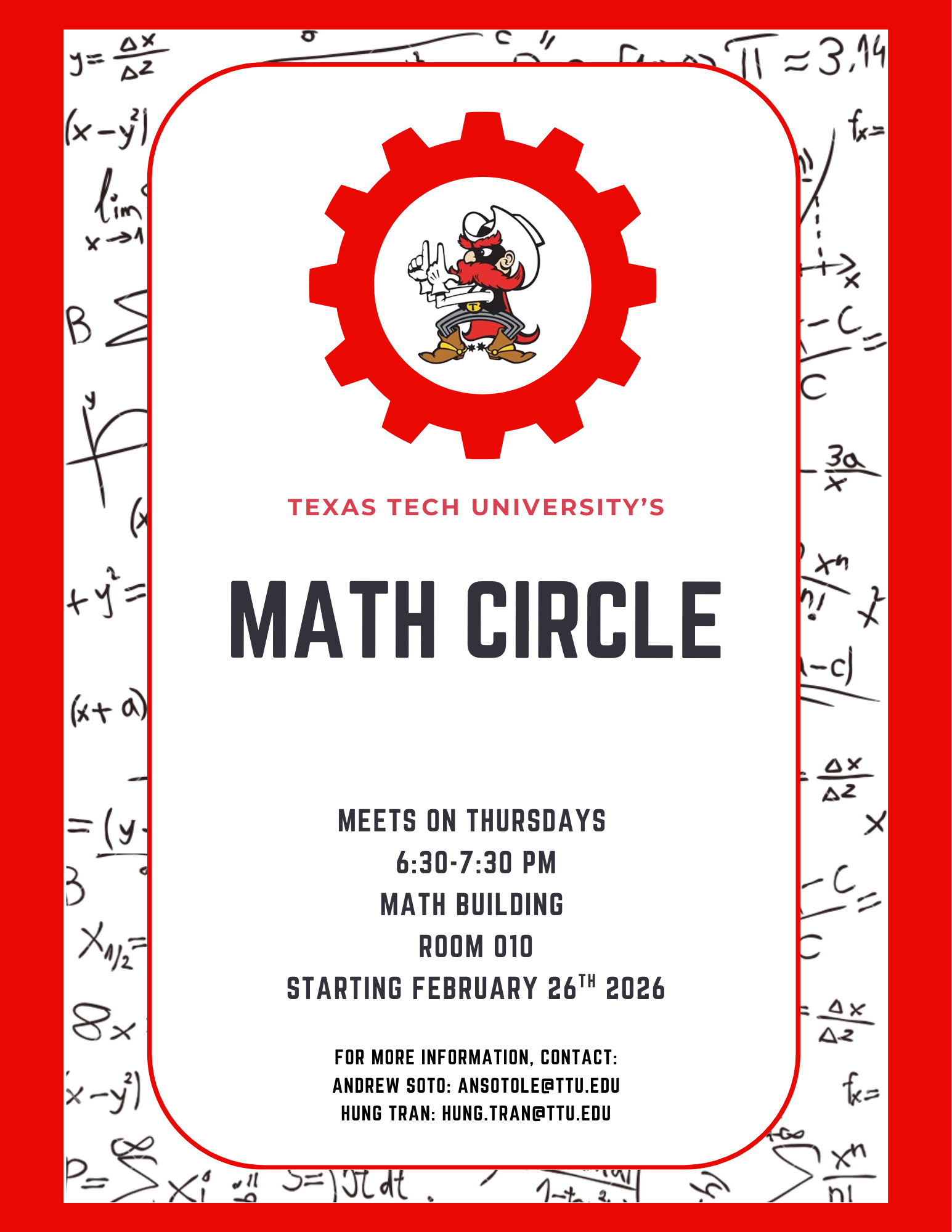
TTU Math Circle Spring Flyer 6:30-7:30 PM Thursdays in the basement of Math, room 010
Cancer is complex, working at multiple spatial and temporal scales, underpinned by a convoluted network of cell cycle controls and cell-cell interactions. Heterogeneity of cells within tumors has emerged as a key factor in tumor evolution and progression, further adding to the challenge. After introducing some of the complexity we face, I present four modeling approaches: ecological, cell biology, phenotypic evolution, and network evolution. I conclude with some of the mathematical and practical challenges we face in better understanding and controlling cancer initiation and progression.
The Biomath seminar may be attended virtually Friday at 11:00 AM CDT (UTC-5) via this Zoom link.
Meeting ID: 938 8653 3169
Passcode: 883472
abstract 2 PM CDT (UTC-5)
Zoom link available from Dr. Brent Lindquist upon request.